Mom’s Question

My mom has been reading my blog from my Ciclismo Classico tour of the Alps and the Dolomites. In an email yesterday, she commented and asked the following:

I am enjoying your blogs.  They are very informative and make me want to see  this part if Italy but without the pain and suffering.  Do cyclists at your  level really enjoy this or is it the thrill of conquering the mountain that  makes you do it?

I answered by saying the following:

Despite all my whining about the pain and suffering, the answer to your question is yes, cyclists at my level do enjoy this. It’s not the pain and suffering that we enjoy, but rather the challenge, the scenery, and conquering rides that usually only the pros complete.

I’m sure you all have other reasons why you put yourselves through the pain and suffering, right? Please answer in the comments section below and let me know what you would have answered.


Maratona Tour – Day 4 (Pinei and Sela)

Today’s Distance: 70.4 KM
Total Distance for the Trip So Far: 268.5 KM
Today’s Climbing: 2,318 meters
Total Climbing for the Trip So Far: 6,075 meters
Today’s Kit: Republic of Anaerobia (Veni, Vidi, Vomiti)

NOTE:  Scroll all the way to the bottom for photos and maps/metrics from today’s ride.

Before leaving Bolzano we participated in a Ciclismo Classico tradition: the transfer of the capelino. The capelino is a white cycling cap with the tre colori of Italy striped down the middle from front to back. On the first day of the trip, the capelino is given by the guides to a deserving person for whatever reason they see fit. On subsequent days, the recipient of the capelino is decided by the current holder. I received the capelino yesterday from Bettina, in appreciation for my stopping on the Stelvio to give her a Clif bar and for allowing her to use one of my jackets on the descent (her luggage was lost on its way here). Today, I gave the capelino to Jacob who, prior to two months ago, was a marathon runner and not a cyclist. He is doing very well on this trip and I wanted to recognize his efforts by writing on the capelino, ‘To Jacob. From marathon to Maratona.’

Once the briefing and capelino ceremony were behind us we had one more thing to do before leaving Bolzano. One of the participants wanted to get a glimpse of the Bolzano Museum of Modern Art, with its glass facade and twisty glass bridges. A few photos later, we were finally on the road to Canazei via two passes, the Passo Pinei and the Passo Sella (the latter is part of Sunday’s Maratona). Just like when I rode my bike on the big island of Hawaii, today’s ride was all up.

It was a cloudy day today, as you’ll see from the photos below, and Enrico says that if the weather had been clear we would have been bowled over by the views. The clouds kept the temperatures down, but the humidity was high, so it was another sweaty day. The Pinei was difficult in spots, but there were brief respites that helped quite a bit. At one point, Enrico stopped the van at a wide bend in the road for everyone to replenish food and water. Just past the bend was a road with a sign indicating that it was a 28% grade. Every person who arrived was told that was the way we were going next, and most believed for the briefest of moments until the oxygen returned to their brains and common sense set in. We all took pictures anyway, planning to tell our riding buddies about the 28% grade we tackled in Italy. Shh! Don’t let the cat out of the bag.

From the top of the Pinei we had a brief descent before beginning the Passo Sella. A few kilometers into the climb we stopped in Santa Cristina for lunch, one of the two lunches on the trip hosted by Ciclismo Classico. Santa Cristina is a small ski village with a warm ambience, lots of shops and restaurants and a full complement of lodging choices. It reminded me of Le Grand Bornand in the French Alps; I would love to return to either place with my family someday for a ski vacation. I had risotto with asparagus and mushrooms for lunch, which helped soothe my tired body and bring it back to what felt like full strength, but once back on the bike and climbing Passo Sella, it sat in my gut like a rock. In retrospect, I probably should have just had pizza.

The Passo Sella was brutal and beautiful, as the climb was unrelenting until the summit, while the clouds revealed the scenery we had all come to enjoy. I was relieved and elated to reach the top, lingering long enough for the obligatory photo with the summit marker sign, as well as several other shots of the surrounding beauty. I have never seen anything like The Dolomites before and despite the pain and suffering, I am glad I came.

It was an 11 km descent to Canazei and then a 3 or 4 km slight rise to our hotel. Once again, Ciclismo Classico has outdone themselves with this evening’s lodgings at the Hotel La Cacciatora. This is another four star hotel with a beautiful room with wood paneling, moulding and ornate ceilings. My room has a flower box lined balcony that overlooks the parking area and the nearby mountains. Our four course dinner (after a tour of the wine cellar where we saw €1,200+ bottles of wine) included a salad bar, and I had (in order of appearance) the smoked meat plate, tagiatelle in venison sauce, grilled rabbit with a potato pancake, and cherry strudel with ice cream. Yes I am full, and no I do not feel guilty considering all the calories I am burning each day.

Tomorrow is another tough day as we go over two more Maratona climbs, the Falzarego and the Valparola, and we’ll also do Passo Fedaia.

One more note. As you may know, the Maratona has three courses: the Sella Ronda (55 km + 1,780 m), the Percorso Medio (106 km + 3,090 m), and the Percorso Maratona (the big banana at 138 km + 4,190 m). Based on my performance on this week’s tour so far, I am nearly 100% certain that I will not attempt to tackle the Percorso Maratona. I am going to shoot for the Percorso Medio and either complete it, bail on it for the Sella Ronda, or decide at the bailout point to continue on with the Maratona. Time will tell.


Maratona Tour – Day 3 (Passo Palade & Mendola)

Today’s Distance: 81.7 KM
Total Distance for the Trip So Far: 198.1 KM
Today’s Climbing: 1,678 meters
Total Climbing for the Trip So Far: 3,757 meters
Today’s Kit: Team Saxo Bank

NOTE:  Scroll all the way to the bottom for photos and maps/metrics from today’s ride.

Last night we stayed at the Hotel Hanswirt in a small town called Rablá, near Merano. From the outside, it looked pleasant enough, with a lovely restaurant with seating inside as well as on a very pleasant patio complete with a fountain and a garden under glass bricks beneath the tables. The hotel seemed to be attached to a large barn with a huge statue of Jesus on the cross at the peak of the roof, and there were religious artifacts and, curiously, typewriters used as decorations throughout the hotel.

You’re starting to wonder why I want to rave, right? Wait for it.

Everything about this hotel (except, perhaps, for the lack of air conditioning) was phenomenal. Rated four-stars, each room was spacious (read: huge), with a large comfortable bed, sitting area, desk, flat screen TV, enormous bathroom with shower AND bath, toilet AND bidet, and more counter space than I am used to in a hotel.The closet was larger than a hotels I remember on business trips in Kobe, Japan, and London. No, really.  I also had a large outdoor deck that overlooked the pool and the nearby mountains.

Our bikes were stored in the Fahhrad-Depot (fahhrad is German for bicycle). How many hotels have you visited that had a Fahhrad-Depot?

Our group dinner was on the patio at a long table set up for all 20 of us (remember, Guido joined the trip yesterday as a guide, luggage van driver, and videographer). The food was excellent, the service good, and the view fantastic. All-in-all (other than the painfully slow WiFi), a wonderful experience, which continued this morning with breakfast, which was the typical European buffet including the usual quality European coffee.

By 8:30 AM, it was time to leave the lap for the saddle of pain (please note that I am sparing you the details so as not to be the butt of any jokes — get my drift?), and begin our ride.

Today we rode from Rablá to Bolzano (see Day 0) via the Passo Palade (1,193 meters of climbing) and the Passo Mendola (371 meters of climbing). The Passo Palade is a 16 km climb with an average grade of 7.4%, which may not sound too bad, but there are very few turns.

So what? you may be wondering. And since I know my mom is reading this blog, this answer may just be for her (Hi Mom!). The Passo Palade is mostly straight road that heads up the mountain with only occasional turns as it reaches toward the saddle at the summit of the pass. The Stelvio, on the other hand, is a much older road that was engineered and built using mostly short stretches of straight road, and frequent turns or switchbacks. While the Stelvio was longer and steeper overall, the road flattens out a bit (not flat, just less of a gradient) in the turns.

Complicating matters further was that the Palade and the Mendola are both lower elevation passes (therefore naturally warmer) and today was a hot, humid day. Despite all of these challenges, I found a pace on each climb, kept a steady cadence, and made my way to the top of each somewhere in the middle of the pack.

Massimo, who was driving the van today (they switch off each day), knew how hot it was and made sure to stop several times on the climb to make sure everyone had full water bottles. This was a huge help!

After summiting the Palade, we had a 10 km descent and then an 8 km climb to the top of the Passo Mendola where we had lunch. From there, it was all downhill into Bolzano, including 14 km at the end on Bolzano’s fantastic bike paths. The one we started on used to be the railway line, now converted to a bike path. As we got closer to Bolzano, however, the signage and frequent intersecting paths made clear that Bolzano’s city leaders are progressive when it comes to ensuring alternative transportation, specifically bicycles. We were all quite amazed at the network of bikeways as well as how well maintained (or should I say landscaped?) they all are. Bravo, Bolzano!

Our hotel tonight is the Stadt Hotel Citta, the same hotel in which many of us stayed the night before the tour officially began. It is perfectly situated on one of the city’s main piazzas, right across from il Duomo. The Duomo has Romaneque and Gothic elements and was consecrated in 1180. Partially destroyed in World War II, it was painstakingly rebuilt, brick-by-brick (shrapnel scars can be seen everywhere). The hotel is very nice, with clean well-appointed rooms (and a fantastic breakfast), and allows cycling guests to store their bikes in the lobby.

Bolzano is a pretty little town with a vibrant merchant culture that dates back nearly a thousand years due to its location at the middle of Swiss, Austrian and Italian trade lines and borders. Today it is considered the Gateway to The Dolomites and the Capital of the Alps (along with Innsbruck, Austria). The entire town is flanked on three sides by towering mountains, including The Dolomites clearly visible in the distance.

Bolzano is also the home to Ötzi, the iceman, a prehistoric man found mummified and perfectly preserved in snow and ice high in the nearby Alps in the late 1990s. Carbon dating indicates that Ötzi is over 5,000 years old. The Archeological Museum has him on display and, perhaps even more interesting than the man himself, all of his clothing, tools, weapons and other personal items. I visited and it was facinating.

This Ciclismo Classico tour includes all breakfasts, two lunches and all but one dinner. Tonight was the night we were to have dinner on our own, so most of the North Americans met in the lobby for a short walk to a nearby cafe where we enjoyed excellent pizzas, salads, and risottos. Afterward, several of us made the trek across town to Officina Del Gelo Avalon, which Enrico says has the best gelato in all of Italy. It was very good.

I’m told that tomorrow will be our biggest climbing day so far, but I’m choosing not to think about it.

Buonanotte, amici!


Maratona Tour – Day 2 (Passo Stelvio)

Today’s Distance: 98.7 KM
Total Distance for the Trip So Far: 116.4 KM
Today’s Climbing: 1,974 meters
Total Climbing for the Trip So Far: 2,079 meters
Today’s Kit: Press Camp Jersey & Socks

NOTE: Scroll all the way to the bottom for photos and maps/metrics from today’s ride.

I guess I was pretty worried about today’s climb, because I recall having a dream about it last night, although I don’t remember the details. I do know that I woke up at about 5:00 AM feeling nervous and couldn’t get back to sleep. Several of the other guests on the trip had similar experiences, so it was comforting to know that I was not alone.

We all met for breakfast at 7:30, then met downstairs at the bike garage at 8:30 where we loaded our luggage onto a van being driven by a new arrival, Guido. He’ll be driving our luggage to each hotel and taking videos of us along the route.

Today it was Enrico’s turn to drive the van, and Massimo’s turn to ride. We got another reminder about how to safely descend a big mountain pass, and a long briefing on the route we’d be taking. Today’s ride would begin with a 30 km climb up the Umbial and Stelvio Passes, including a stint in Switzerland and a 3 or 4 km dirt section.

The Stelvio Pass is Europe’s highest road pass. Closed in the winter, it is famous as the site of fierce fighting during World War I, as the ‘greatest driving road in the world’ according to the British TV Show Top Gear, and as the site of nine stages of the Giro d’Italia, including Fausto Coppi’s famous victory in 1953, when he was the first over the summit the first time the Giro headed over Passo Stelvio. As a result, the roads are jammed with cyclists, motorists and motorcycles.

We began our ascent from Glorenza via the Passo Umbrail, climbing steadily up from the valley below. The group quickly split into several smaller ones and I found myself somewhere in a middle group. My heart rate was higher than I’d like it to be, perhaps due to a combination of nerves, lack of training time, and the three or four coffees I had at breakfast. We passed through the Swiss border and continued climbing until we soon made a left turn and headed up the steeper sections of the Umbrail. I climbed alone for a long time, keeping Greg and Bettina in my sights, but by the time we hit the Stelvio they were way up the road and I was climbing with two Venezuelans and one American behind me.

News Flash! It turns out that none of the guys who I previously identified as Floridians are actually from Florida. One of the Venezuelans, il Maestro, told me that the mail is so bad in Venezuela that if they actually want to get something, they use a mail service in Florida.

We all met up on a switchback to get something into our stomachs and then began to climb together. I was marveling at the fact that while I was in the Autobus, I was certainly not going to be the Lanterne Rouge. Meanwhile, I was also out of water and Enrico was nowhere in sight; he was at the top of the climb supporting the riders who arrived earlier. The descent from the Stelvio is so steep and at such a high altitude that you need to put on warm clothes prior to the descent.

As a result, by the time we reached the 3 km to the summit mark, I was toast. Cramps set in to my thighs and I had to stop to down some electrolyte pills with the little water I had. The rest of the guys were sympathetic, but ready to reach the summit and went on without me. Thankfully, the electrolytes did their job and I summited just a short time after the rest of the group, although the pro who passed me like I was standing still (I probably was) and the constant noise and exhaust of the passing motorcycles certainly didn’t help.

Once at the top, we all had some food and water, took the obligatory photos with the Fausto Coppi monument and the summit sign, then put on our warm clothes (so glad I bought that new wind jacket the night before I left!) for the long descent to lunch. The descent was steep, technical and cold, requiring constant attention, good bike handling, and occasional stops to let the fingers, back and neck stretch out.

We regrouped for lunch in Prato Allo Stelvio at the base of the Pass, then continued another 60 km or so to our hotel for the evening. Everyone summited, nobody got hurt. We celebrated at dinner and are now looking forward to tomorrow when we’ll do another 80 km or so and about 1,900 meters of climbing.

Ciao for now!

Maratona Tour – Day 1 (Glorenza)

Today’s Distance: 11.7 KM
Total Distance for the Trip So Far: 11.7 KM
Today’s Climbing: 105 meters meters
Total Climbing for the Trip So Far: 105 meters
Today’s Kit: Utah Bike MS Jersey and Socks

Note: no internet connection here, so I used as little 3G as possible to send this via my iPhone. I’ll add photos when I find internet — hopefully tomorrow.

Perhaps my circadian rhythm is different from that of many other humans I know, but I am apparently relatively immune to jet lag. Oh sure, I get tired from having a 34 hour day, crossing an ocean (not that this involved any real work on my part other than pushing the button to put my upgraded airline seat into its horizontal nighty-night position), and lugging a huge duffel bag through airports, train stations and cobblestone streets, but I just don’t have trouble getting to sleep at the right time, staying asleep all night, or waking up at an appropriate local time. And today was no different.

I woke up at 8 AM this morning and was at breakfast by 9 AM. When I walked in, I met the first of my trip companions, Dave Nanian from Shirt Pocket Software. Dave and I had been trading tweets for the past few weeks as we prepared for, and shared anxiety about, this trip. I am also a user and fan of Dave’s MacOS backup solution, Super Duper which I think is, well, super duper! We had a nice breakfast and good conversation as we shared our life stories and anxieties about the week of difficult climbs. Dave has traveled with Ciclismo Classico previously and has nice things to say about the organization, the itineraries, and the guides.

While at breakfast, we ran into our two guides, Enrico and Massimo. Both are veterans of guiding trips for Ciclismo, natives of Italy (in case you were wondering where they got those Italian names), and both are experienced cyclists. They have excellent senses of humor, enjoy a good joke, but can also be serious when necessary. Their English is superb too, by the way.

Speaking of breakfast, for those of you who haven’t had the chance to get to Europe yet, a few notes about European breakfasts. Many hotels in Europe include breakfast buffets in the price of lodging or charge just a few extra Euros for the buffet. Don’t expect the typical American fare of scrambled eggs, hot smoked pork products, fried potatoes, etc. Instead, European breakfast buffets consist of hard breads and rolls, a variety of cheeses, fruit, yogurt, croissants, the occasional smoked salmon, and what Americans consider luncheon meats (ham, salami, prosciutto). Water (both with and without gas) is available, along with a variety of juices, but the glasses are usually so tiny that if you want more than a tablespoon-size sip, you’ll need to take several glasses.

And then there’s the coffee.

I am what many would call a coffee achiever (some, especially those with whom I work, might call me a coffee over-achiever). I love coffee. I have three coffee machines at home (a traditional coffee maker, a Keurig capsule-based machine, and a Nespresso espresso/cappuccino maker) and a little Nespresso gizmo just for frothing milk. The coffee in Europe, especially in Italy, is a good enough reason to hop on an Alitalia flight and come here. Well, maybe not Alitalia, but I digress. When you do come here, you’ll find out that people here are passionate about their coffee and that drinking it is an event, a national pastime of sorts. With that in mind, it is always curious to me when the waiters and waitresses at breakfast here always look at me askance when I ask for a second (sometimes a third) espresso at breakfast (as they did this morning).

After breakfast, I packed up and lugged Kitchen Sink 9000 the two blocks or so to the train station to meet the rest of my tour companions and our guides. Upon seeing Kitchen Sink 9000, the guides decided we were going to need a large shuttle bus. No, not really. Actually, someone else on the trip has a Kitchen Sink 9000 just like mine, except he hasn’t utilized its full capabilities as I clearly have.

We packed all of the luggage into Ciclismo’s van, while the participants got onto a mini bus for the hour or so drive to our first official hotel in Glorenza. During the drive we had a chance to introduce ourselves to each other, chat, and lie about our capabilities on a bike. Everyone is friendly and eager to get along, but we all think everyone else is a sand bagger. They’d be wrong in my case.

The participants in our trip are from the U.S., Canada and Venezuela (and yes, those were the Venezuelans I spotted at dinner last night). The North Americans are from British Columbia, California, Massachusetts, Colorado, Illinois, Texas, Florida and, of course, Utah. Including Enrico and Massimo, there are 19 of us traveling throughout Tyrol. The Floridians (5) and the Venezuelans (3) are pals, so while we are all friendly and talkative with each other, we seem to gravitate into two subsets (the Floridians/Venezuelans, and the rest of us).

Interesting side note: The two gentlemen from Houston have houses in Park City, where they like to ski, mountain bike and road bike. We’ve compared notes on home locations, bike routes, favorite ski runs, restaurants, etc.

Glorenza, the site of our first night’s hotel is a beautiful example of a walled medieval village, with intact 20-foot high walls with rounded turrets, wooden bridges, and a church dating to the 1400s with charming bells that chime every 15 minutes. We arrived at our hotel, checked-in, then dressed for cycling and met for lunch. Lunch consisted of a mixed green salad (with beets — good for athletic performance!) and Italian cold cuts, cheeses and breads. Lunch also included Proseco. Bienvenue a Italia!

Afterward, those who brought bikes (3) unpacked and built them, while the rest of us were fitted onto the Bianchi bikes that Ciclismo has in their rental fleet. Each is an aluminum frame with Campagnolo 10-speed in the rear and a triple up front. While everyone was getting ready, I installed my Cycleops wheels, Garmin 500 computer, speed/cadence sensor, and the handlebar mount for my GoPro Hero HD. Once the bikes were built, we went for a 17 km shakedown cruise that included a stop at a local bike shop for those who may have forgotten items, or whose luggage was lost by the airlines. Some of the group opted for an additional 5-7 km climb up the lower slopes of the Stelvio Pass. I passed (ha) figuring I am about to get plenty of climbing, thank you very much.

Dinner this evening was a 4-course affair (including wine, we are in Italy after all) back at the hotel and included a briefing by Enrico on the proper way to descend steep, technical mountain passes like Stelvio. Tomorrow’s descent will be long (about 25 km) and includes many switchbacks, so despite the obvious cycling experience of everyone in the room, the room was quiet during the briefing.

Think good thoughts and wish me luck on the Stelvio tomorrow. I expect to be the last one to the top, hopefully without making everyone else wait too long! In the meantime, Buon quattro di luglio di Italia!

 

Assos Interview at Press Camp 2011

<iframe width=”560″ height=”349″ src=”http://www.youtube.com/embed/vrV9RuoA7jU” frameborder=”0″ allowfullscreen></iframe>

Maratona Tour – Day 0

In case you don’t know by now, I travel for work. A lot. Last year, for example, I logged more than 100,000 miles on Delta Airlines and am on pace to do it again this year. As a result I a) have lots of time and experience in every mode of travel used in the western world, and b) have lots of miles accumulated for family vacations, college orientation trips (although I’m glad I’ve completed half of the two I’ll need to experience in my life), and possible cycling vacations. So when Andrew from Ciclismo Classico told me that all I needed to do was get myself to the starting point of one of their tours, I figured it would be una pace di torta.

My day began this morning at 6:00 AM Mountain Daylight Time with my alarm going off and my dogs hungry for breakfast. I tried to ignore both, but each can be quite persistent in its own way. I snoozed the dogs and provided two healthy bowls of kibble to the clock (or at least that’s how it seemed in my sleep-deprived stupor) before tramping off to the trusty Keurig for a cup of my new favorite, Island Coconut.

Standard operating procedure for me on a travel day is to grab my iPhone and check my FlightTrack app to ensure that my outbound flight is on time. This morning, it was delayed 45 minutes. That gave me extra time to go over what I’d packed to ensure that I’d brought everything I might need — not necessary really, as I brought my famous Kitchen Sink 9000 rolling duffel bag and stuffed it to the gills with all manner of lycra, chamois cream, saddle sore medication, and at least one of everything from the Hammer Nutrition catalog. I’ve also got a messenger bag with (I am not making this up) two iPhones, an iPad, a MacBook Pro, a GoPro video camera, a Flip MinoHD video camera, and a Canon compact digital camera. And of course I have shoes, pedals, saddle, helmet and wheels (shipped separately, of course. I am no overhead bin hog thank you very much). Uh, I brought some clothes too. Cycling clothes, casual clothes, going out to dinner clothes, sleepy time clothes . . . you get the picture. Boy Scout? Yep!

Once the Sherpas loaded up the yaks, we headed down the canyon from Park City to Salt Lake City International Airport where Mrs. FredCast and I did our usual goodbye ritual (which usually elicits all manner of disgusted sounds from our kids, but it was before Noon on a weekend so they were still sound asleep) and I then headed inside for check-in. Although I’m traveling on a free ticket purchased with miles, I mercifully still get the benefit of checking in at the Medallion, er Sky Priority, counter and using the special Sky Priority security lane to fly (sorry) through TSA and head to the gate. Delta also allows Medallions to request domestic upgrades on tickets purchased with miles and my upgrade for the SLC-JFK leg came through last week.

Once airborne, the flight to JFK was uneventful, and my experience at JFK was as per usual — it remains my least favorite domestic airport. Sorry, New Yorkers.

IMG 1405

I boarded my JFK-Milan flight on time and was initially upset when the boarding pass scanner at the gate beeped, seemingly indicating that Delta’s computers wanted a fifth check of my passport.

Imagine my surprise, however, when a Red Coat walked up, thanked me for my loyalty to Delta, and handed me an upgrade. Wait. I thought you couldn’t get an upgrade on an international mileage-purchased ticket (said the angelic voice in my head)? Shut up and say thank you to the nice lady (said the devilish voice in my head)! I followed the advice of the devilish voice.

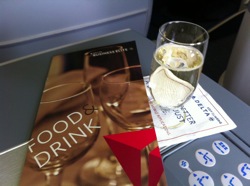
Needless to say, my flight to Milan was very comfortable, with plentiful and tasty food, free-flowing champagne and wine, and a lay-flat seat that has now ruined me forever when it comes to sleeping on planes.

IMG 4071

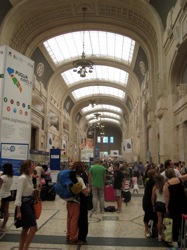
We arrived in Milan at a little after 8:00 AM, and by 9:00 AM I was on the Malpensa Shuttle bus headed for Milano Centrale train station. Unfortunately, I neglected to make my train travel reservations prior to leave the States so although I arrived at the station before 10:00 AM, the first available train to Bolzano wasn’t until 12:05 PM. This gave me a chance to have my first espresso of the trip, along with a bottled water and a croissant.

The train from Milan to Verona was good, except for the Chinese tourists who insisted upon blocking the exits with their huge suitcases. Several Italian passengers got quite upset. After much yelling, arm flailing, and the intervention of a train conductor, the tourists moved their bags and serenity returned to the carriage.

Ninety minutes later we arrived in Verona where I was momentarily unable to figure out why there was no train to Bolzano listed on the departures board. The nice lady in the Info booth explained that I had just missed the train to Modena (it left two minutes before our conversation), but that if I waited until 3:09, I could take the ‘regular’ train to Bolzano. I soon learned that regular means local, as the usual ninety minute train ride to Bolzano took in excess of 120 minutes, stopping in every hamlet (pun intended, for the benefit of the thespians and Shakespeare scholars in my household) in Northern Italy.

Bolzano Town Square

At long last we reached Bolzano.

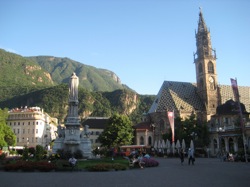
Apparently the Sherpas are on strike here today because I had to lug the Kitchen Sink 9000 off the train myself and wheel it the two blocks or so to my hotel, the Stadt Hotel Citta, which is the same hotel we’ll stay at on Wednesday night during our tour. The hotel is located right on the main square in Bolzano, a beautiful spot that overlooks the town’s main church and is framed by some of the nearby mountains.

For the final hour or so of trip from Verona to Bolzano, the train moved through valleys flanked by some of the tallest, steepest mountains I have ever seen. They are at once stunningly beautiful and intimidating. My legs hurt just looking at them, and even now I get a twinge of pain in my hamstrings just thinking about them. I don’t recall this level of fear and trepidation when I went to the French Alps.

I walked around town a bit this evening and found that this region is mired in a bit of schizophrenia. Placed as it is in Italy, squeezed between Austria and Switzerland, it seems that the region is a bit undecided about its identity. Signs and menus are in both Italian and German, the official desserts here include both gelato and strüdel, and the architecture is decidedly GermaniRomanSwiss.

I had a wonderful Italian meal at the hotel’s streetside cafe, including prosciutto, risotto, and a fine after-dinner espresso. Since the tour doesn’t officially begin until our meeting back at the Bolzano train station in the morning, I gave every tourist I saw the once-over (Are they wearing a LiveStrong bracelet? Do they have an athletic build? Check for muscular, sinewy legs and/or arms. Etc.) trying to determine which of them will be on the tour with me and whether they are in better shape than I am. I am fairly certain I picked out the guys from Florida and Caracas (who look fitter than I), but wasn’t able to make an ID on the others. I’ll meet them soon enough.

Tomorrow’s plans are to meet at Noon, take a shuttle bus to our first official hotel in Glorenza, build and/or fit bikes, then go for a quick 10 mile shakedown cruise in preparation for The King (the Stelvio Pass) on Tuesday. For now (34 hours after feeding the clock and snoozing the dogs), I think I’ll finally get some rest. Meanwhile, I hope the Sherpas end their strike soon. I’m gonna need them to pull me up those climbs later this week.

Maratona Tour – How I Got Here

Several years ago I was approached by Andrew Conway, US Managing Director of Ciclismo Classico, asking if I would be interested in taking one of his company’s cycling tours. At the time, I was planning a tour to the French Alps with another company and therefore had to put him off.

If you’ve listened to The FredCast for any length of time you know that this first trip to ride the famous climbs of the Tour de France was a dream come true for me. On the very first episode of The FredCast, I told my listeners that I would never ride L’Alpe d’Huez, and yet there I was on August 30, 2008, climbing the famed switchbacks on my faithful Colnago. And Alpe du Huez was just the icing on the cake, as we had already climbed the Col de la Madeleine, Col du Telegraphe, The Galibier and more! Most of the climbs we tackled that week were Hors Categorie climbs, complete with road graffiti, expansive vistas, punishing grades, and the wind whispering the names of famed cyclists who had suffered or succeeded on these very same roads. Did I say the trip was a dream come true?

The next time Andrew approached me, I had just taken on a new sponsor for the show with whom I had planned another tour to the French Alps, a tour which was to include famed American cyclist Tyler Hamilton (yes, that Tyler Hamilton). Once again, I had to put him off. Perhaps it was the economy, perhaps it was (at the time) the suspicions, innuendo, and suspensions surrounding Tyler, but that trip never garnered enough reservations to actually get off the ground.

Patient, optimistic and persistent, Andrew approached me again in the summer of 2010. I happened to be passing through Logan International Airport on my way to a Labor Day weekend Maine vacation with my daughter, so Andrew and I met in a pub in Boston’s South Station, had a couple of beers, and enjoyed a good meal. But what I will remember most about that evening was Andrew and his passion for Ciclismo Classico.

If you hang around bike industry people long enough, you’re bound to hear an old saw or two about the inability for anyone to make real money in the industry. Some say to make a million dollars, you need to start with two million. Others simply say that you can’t make money in the bike business. But any who have actually worked full time in the industry will tell you that having an occupation in an industry that is also your avocation (and passion), is more rewarding than so-called ‘real work.’ Andrew seems to me to be one of those people.

Now I don’t know whether those old sayings about bicycle industry jobs extend to bicycle travel companies, but it doesn’t matter. Andrew clearly loves what he does, believes in the company for which he works, and has a passion for bicycles, travel, business, and Ciclismo Classico. He’s the kind of person who not only helps ensure that his guests have the trips, née adventures, of their dreams, but he also lives the life, taking his own family on tours by bicycle right here in the United States.

During that dinner in Southie, Andrew talked at length and with great enthusiasm about Ciclismo’s dedication to providing high quality tours around the world, with an emphasis on journeys through Italy. He explained their process of creating trips, selecting guides (all of whom are local to the areas through which they guide their guests), choosing hotels, creating routes, and managing all of the details of the several dozen trips Ciclismo Classico runs each year. I was captivated by his descriptions, although my interest had already been piqued by the descriptions of Ciclismo’s tours by my good friend Carlton Reid.

At the conclusion of our meal, Andrew I agreed that his company would advertise on thefredcast.com, that I would join a Ciclismo Classico tour in 2011, and that I would report, honestly and openly (i.e. the good, the bad, and the ugly) on my experiences to FredCast listeners. I cautioned that I could I would not sugar coat my reports, and he was just fine with that.

As we went our separate ways that evening, Andrew handed me a Ciclismo Classico catalog and told me to choose a tour I’d be interested in taking. He encouraged me to consider one of the less strenuous Italian tours because, he said, this would provide a nice contrast to the difficult Alpes tour I had taken a few years previously. In retrospect, and considering the amount of time I’ve been able to devote to training this year, that is advice I should have taken. The tour I actually chose was one described as ‘Famous Alpine Passes and The Maratona dles Dolomites.’

The Maratona dles Dolomomites (literally, The Marathon of The Dolomites) is perhaps the world’s most famous (and most difficult) Grand Fondo event, a 130 km slog through the spectacular Dolomites surrounding Corvara, Italy, with over 14,000 feet of vertical gain — in one day. Coach Richard Wharton recently described The Maratona to me, as another of those cycling ‘bucket list’ items that ranks up there along with climbing Alpe du Huez, completing your first century/double century/race, and watching the Tour de France in person. And that’s why I chose it.

And if The Maratona sounds challenging (and it is), our participation in the event occurs on the final day of our 7 day tour through The Dolomites. The days leading up to the main event will take us through spectacular scenery with, as Ciclismo says, a ‘daily backdrop of soaring spires, waterfalls, and cool forests’ to ‘ride some of the world’s most spectacular mountains.’ Want an example? Day 2 of our tour takes us up the famed Stelvio Pass, the site of famed battles in the Giro d’Italia including Fausto Coppi’s 1953 victory. The summit of the Stelvio is at more than 2,700m, with an average gradient of 7.5% and a max of 13%.  My legs and lungs hurt already.

All of that brings me to today. The proof of Andrew’s persistence lies in the fact that I am writing this in a caffé bar at the Milano Centrale train station as I await my 12:05 Eurocity departure to Bolzano-Bozen, connecting through Verona (my daughters wanted me to get off and take a Shakespearean site tour). Once in Bolzano, I will stay overnight and then meet the rest of the tour group at the train station at Noon tomorrow for a bus ride to our first hotel in Glorenza and a 10 mile warm-up ride. For authenticity of experience, I have chosen to use one of Ciclismo’s loaner Bianchi bicycles, but I have brought along my own helmet, pedals, shoes, saddle and a set of alloy PowerTap wheels graciously loaned to me by the kind folks at Saris.

I am looking forward to the tour, albeit with some trepidation about my fitness (or lack thereof), but optimistic about my abilities, the ability of Ciclismo’s guides, and the Italian caffé, gelato and strudel (The Dolomites are close the Swiss and Austrian borders) to get me through the suffering that I am bound to experience on Stelvio, Pinei, Sella, and Giau.

I’ll try to report each day in the blog, but you can also expect photos, videos and at least one audio wrap-up at the end of the trip. Meanwhile, enjoy the 2011 Tour de France, the Fourth of July holiday (if you’re in the US), and get out on your bike to enjoy the good weather, good roads, and good camaraderie that summer brings to all cyclists.

Ciao!

Montreal Bixi Bike Share

Here is a quick video I produced from my recent test ride in Montreal, using the Bixi Bike Share system. And yes, I enjoyed the ride!

Photos from 2011 Press Camp – Day 3

Here are photos of some of the products I saw at Day 3 of 2011 Bike Press Camp in Deer Valley, Utah. You can hear about all of these products in Episode 182 of The FredCast Cycling Podcast.

Page 7 of 60

Powered by WordPress & Theme by Anders Norén